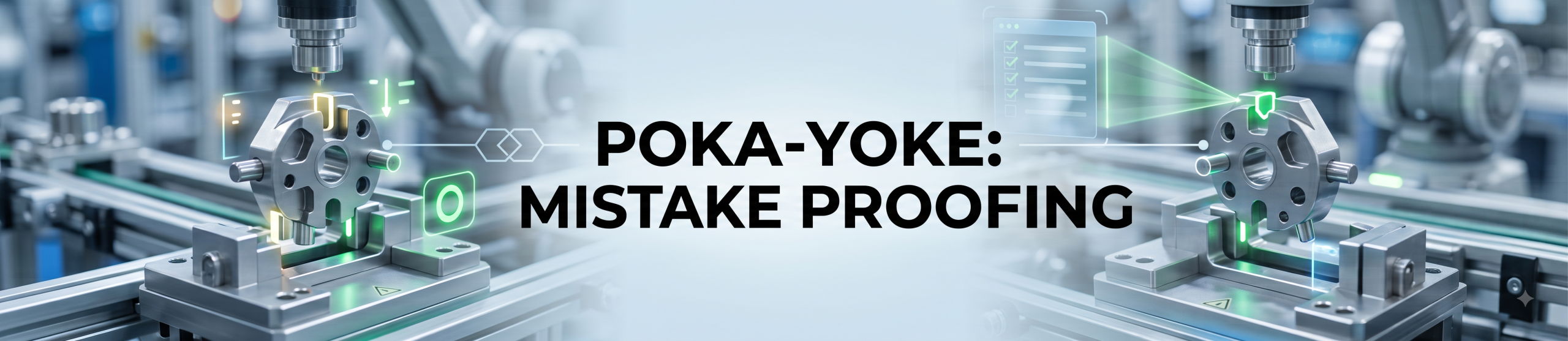
Poka yoke mistake proofing is a topic more manufacturers are researching as they look to modernize operations, and this guide breaks down exactly what it involves and how to approach it in practice.
Poka Yoke is a Japanese manufacturing term that translates roughly to “mistake proofing,” describing techniques designed to prevent errors from happening in the first place, or to catch them immediately if they do occur, rather than relying on inspection to catch defects after the fact.
The Core Idea Behind Poka Yoke
Most quality approaches assume mistakes will happen and focus on catching them through inspection. Poka Yoke takes a different approach: design the process or equipment so the mistake physically cannot happen, or is immediately obvious if it does. A simple example is a connector designed so it can only be plugged in one way, physically preventing a wrong-way connection rather than relying on an operator remembering the correct orientation.
Types of Poka Yoke Techniques
- Contact methods: Physical features that prevent an incorrect action, such as a part that only fits into a fixture one way
- Fixed-value methods: Ensuring a fixed number of actions or components are used, with an alert if the count is wrong, such as a kitting system that flags a missing part
- Motion-step methods: Sensors that detect whether a required step in a sequence was actually completed before allowing the process to continue
Digital Poka Yoke in Modern Factories
While Poka Yoke originated as a mechanical and physical design philosophy, digital systems extend the same idea into process control. A digital checksheet that will not let an operator proceed to the next step without confirming a required check is a form of Poka Yoke, as is a machine interlock that prevents startup unless a safety guard sensor confirms it’s properly in place.
Why Poka Yoke Beats Inspection Alone
Relying purely on end-of-line inspection to catch defects means the plant has already spent time and material producing a defective part before catching the problem. Poka Yoke techniques, by contrast, either prevent the defect from being created at all or catch it at the exact point of occurrence, minimizing wasted material and rework.
Applying Poka Yoke Practically
Manufacturers don’t need to redesign every process at once. A practical starting point is looking at the plant’s most frequent defect types and asking whether a simple physical or digital constraint could make that specific mistake impossible, rather than relying solely on operator attention and training to prevent it going forward.
Poka Yoke Mistake Proofing: Key Takeaways
Getting poka yoke mistake proofing right is less about chasing the latest trend and more about building a habit of measuring before you change anything. Teams that succeed usually start with a single, well-defined process, track it consistently, and only then expand what they’ve learned to the rest of the plant. That disciplined, incremental approach to poka yoke mistake proofing tends to outperform a single big-bang rollout, because each step is validated with real data before the next one begins.
If you’re evaluating poka yoke mistake proofing for your own operation, it helps to talk with a team that has actually implemented it elsewhere, not just read about it. LeMeniz Infotech has supported manufacturers and engineering students with practical, hands-on guidance since 2011, and we’re happy to walk through real examples of poka yoke mistake proofing in practice before you commit to anything.
For broader context on manufacturing modernization standards, see the NIST manufacturing resource center. To see how poka yoke mistake proofing fits into a complete digital factory rollout, explore our Digital Factory suite from LeMeniz Infotech.
Teams rolling out poka yoke mistake proofing for the first time often underestimate how much of the early value comes from simply having consistent, accurate data to look at, rather than from any single advanced feature. Getting the basics right and building the habit of reviewing that data regularly tends to matter more in the first few months than choosing the most sophisticated available option.
Manufacturers who get the most value from poka yoke mistake proofing tend to treat it as an ongoing practice rather than a one-time project, revisiting their approach every few months as conditions on the floor change and new data becomes available to act on.