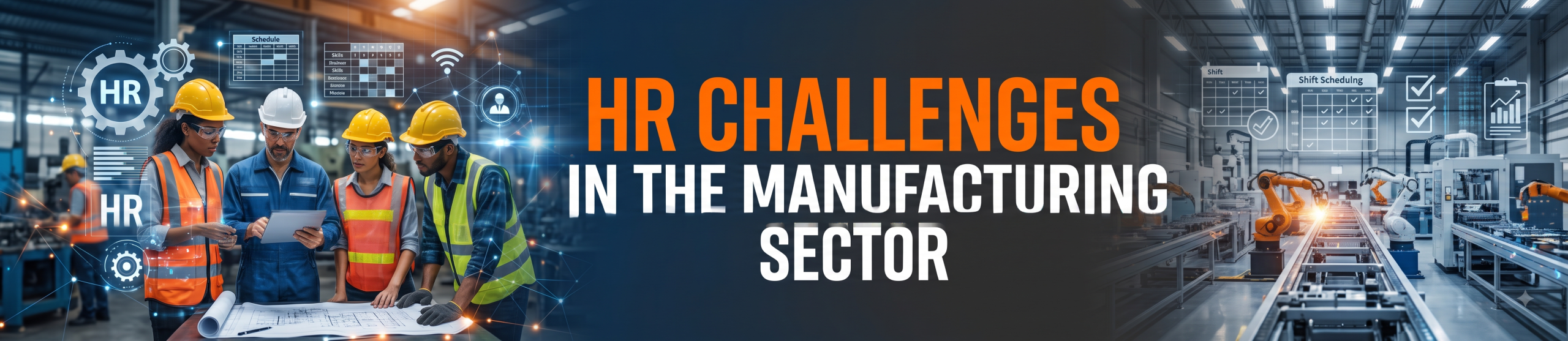
Hr challenges manufacturing sector is a topic more manufacturers are researching as they look to modernize operations, and this guide breaks down exactly what it involves and how to approach it in practice.
Human resources in a manufacturing environment faces a distinct set of challenges compared to office-based businesses, largely driven by shift work, skills-based job assignment, and safety-critical compliance requirements that don’t apply in most other industries.
Shift Scheduling Complexity
Unlike a standard nine-to-five office, manufacturing plants often run multiple shifts, including night shifts, with staffing needs that vary based on production volume. Scheduling has to account for adequate rest periods between shifts, fair rotation of undesirable shifts like nights and weekends, and ensuring the right mix of skills is present on every shift, not just adequate headcount.
Skills-Based Assignment
Unlike many office roles where most employees can perform similar tasks, manufacturing work often requires specific certifications or training before an employee can operate certain machinery. This means HR and production scheduling can’t be fully separated, since staffing decisions have to account for who is actually qualified for a given role, not just who is available.
Compliance and Training Records
Manufacturing employees often need documented training on safety procedures, equipment operation, and compliance requirements specific to their role. Keeping accurate records of who has completed which training, and when certifications need renewal, is a significant administrative burden if managed manually across a large workforce.
How Digital Tools Address These Challenges
- Shift roster systems that account for rest requirements and fair rotation automatically, rather than manual spreadsheet planning
- Skill matrix integration, so scheduling only assigns certified operators to roles requiring specific qualifications
- Automated training expiry alerts, flagging employees whose certifications are approaching renewal before they lapse
- Centralized records that satisfy compliance audits without requiring a manual search through paper files
Why Manufacturing HR Benefits From Purpose-Built Tools
Generic HR software built for office environments often lacks the shift-scheduling and skills-tracking features manufacturing HR teams actually need day to day. Manufacturers that adopt HR systems designed with these industry-specific challenges in mind typically see less administrative overhead and fewer compliance gaps than those trying to adapt general-purpose HR tools to a shift-based, skills-heavy workforce.
Hr Challenges Manufacturing Sector: Key Takeaways
Getting hr challenges manufacturing sector right is less about chasing the latest trend and more about building a habit of measuring before you change anything. Teams that succeed usually start with a single, well-defined process, track it consistently, and only then expand what they’ve learned to the rest of the plant. That disciplined, incremental approach to hr challenges manufacturing sector tends to outperform a single big-bang rollout, because each step is validated with real data before the next one begins.
If you’re evaluating hr challenges manufacturing sector for your own operation, it helps to talk with a team that has actually implemented it elsewhere, not just read about it. LeMeniz Infotech has supported manufacturers and engineering students with practical, hands-on guidance since 2011, and we’re happy to walk through real examples of hr challenges manufacturing sector in practice before you commit to anything.
For broader context on manufacturing modernization standards, see the NIST manufacturing resource center. To see how hr challenges manufacturing sector fits into a complete digital factory rollout, explore our Digital Factory suite from LeMeniz Infotech.
Teams rolling out hr challenges manufacturing sector for the first time often underestimate how much of the early value comes from simply having consistent, accurate data to look at, rather than from any single advanced feature. Getting the basics right and building the habit of reviewing that data regularly tends to matter more in the first few months than choosing the most sophisticated available option.
Manufacturers who get the most value from hr challenges manufacturing sector tend to treat it as an ongoing practice rather than a one-time project, revisiting their approach every few months as conditions on the floor change and new data becomes available to act on.
A Quick Checklist for Hr Challenges Manufacturing Sector
Before rolling this out plant-wide, it helps to confirm three things: that the team responsible for hr challenges manufacturing sector has clear ownership of the data, that there’s a simple way to review results on a fixed schedule, and that early wins get shared back with the floor so momentum doesn’t stall after the first few weeks.