New product development process is a topic more manufacturers are researching as they look to modernize operations, and this guide breaks down exactly what it involves and how to approach it in practice.
New Product Development, commonly shortened to NPD, is the structured process a manufacturer follows to take a product from an initial idea through to full production. For manufacturers that regularly introduce new products or product variants, having a repeatable NPD process is often the difference between predictable launches and constant firefighting.
The Typical Stages of NPD
While every manufacturer’s process looks slightly different, most NPD workflows follow a similar structure:
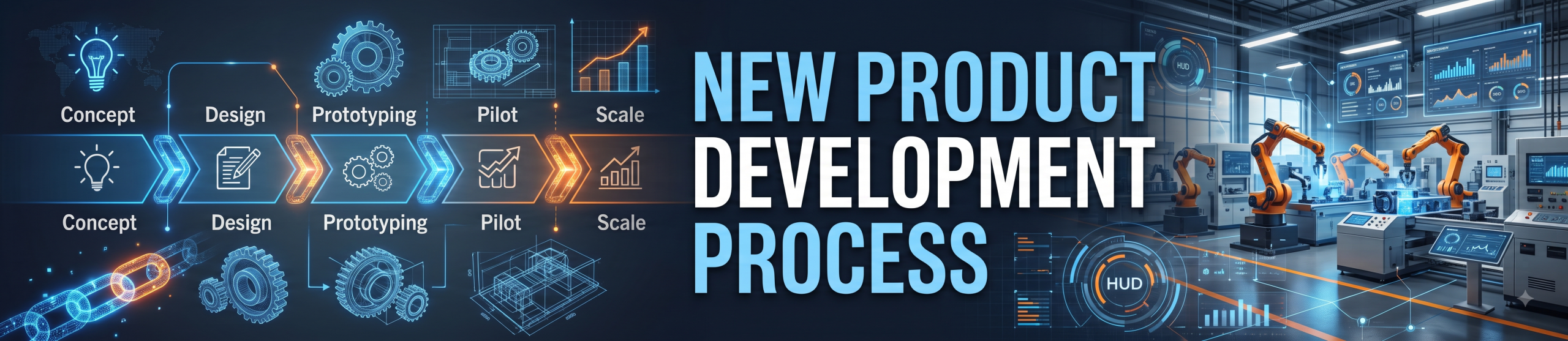
- Concept and feasibility: Evaluating whether a proposed product is technically and commercially viable
- Design and engineering: Developing detailed specifications, drawings, and bill of materials
- Prototyping: Building initial samples to validate design assumptions
- Pilot production: Running a small batch through actual production processes to catch manufacturing issues before full ramp-up
- Production ramp-up: Scaling to full volume once pilot issues are resolved
Why NPD Often Runs Into Trouble
Even with a defined process on paper, NPD projects commonly slip because of poor visibility between stages. A design change made late in engineering might not reach the production planning team in time, or a pilot production issue might get logged in one system while the engineering team works from an entirely separate document. Without a shared, connected system, these gaps between stages are where most NPD delays actually originate.
What Digital NPD Management Adds
An NPD management system keeps every stage of a product’s development connected in one place, so a change made during pilot production is immediately visible to engineering, and a delay in one stage automatically flags its downstream impact on the launch timeline. This does not eliminate the inherent complexity of developing a new product, but it removes the communication gaps that turn a manageable delay into a full launch slip.
Why This Matters for Manufacturing Competitiveness
Manufacturers that can reliably compress their NPD timeline, even by a few weeks per project, gain a real competitive advantage in industries where being first to market with a new product or variant carries commercial value. A structured, digitally tracked NPD process is one of the more overlooked ways manufacturers create that advantage.
New Product Development Process: Key Takeaways
Getting new product development process right is less about chasing the latest trend and more about building a habit of measuring before you change anything. Teams that succeed usually start with a single, well-defined process, track it consistently, and only then expand what they’ve learned to the rest of the plant. That disciplined, incremental approach to new product development process tends to outperform a single big-bang rollout, because each step is validated with real data before the next one begins.
If you’re evaluating new product development process for your own operation, it helps to talk with a team that has actually implemented it elsewhere, not just read about it. LeMeniz Infotech has supported manufacturers and engineering students with practical, hands-on guidance since 2011, and we’re happy to walk through real examples of new product development process in practice before you commit to anything.
For broader context on manufacturing modernization standards, see the NIST manufacturing resource center. To see how new product development process fits into a complete digital factory rollout, explore our Digital Factory suite from LeMeniz Infotech.
Teams rolling out new product development process for the first time often underestimate how much of the early value comes from simply having consistent, accurate data to look at, rather than from any single advanced feature. Getting the basics right and building the habit of reviewing that data regularly tends to matter more in the first few months than choosing the most sophisticated available option.
Manufacturers who get the most value from container logistics tracking smart factory tend to treat it as an ongoing practice rather than a one-time project, revisiting their approach every few months as conditions on the floor change and new data becomes available to act on.
A Quick Checklist for Container Logistics Tracking Smart Factory
Before rolling this out plant-wide, it helps to confirm three things: that the team responsible for container logistics tracking smart factory has clear ownership of the data, that there’s a simple way to review results on a fixed schedule, and that early wins get shared back with the floor so momentum doesn’t stall after the first few weeks.
None of this requires a massive upfront investment. Most plants that succeed with container logistics tracking start with a single line or a single shift, prove the value with real numbers, and only then expand the approach across the rest of the facility.