Production scheduling fundamentals is a topic more manufacturers are researching as they look to modernize operations, and this guide breaks down exactly what it involves and how to approach it in practice.
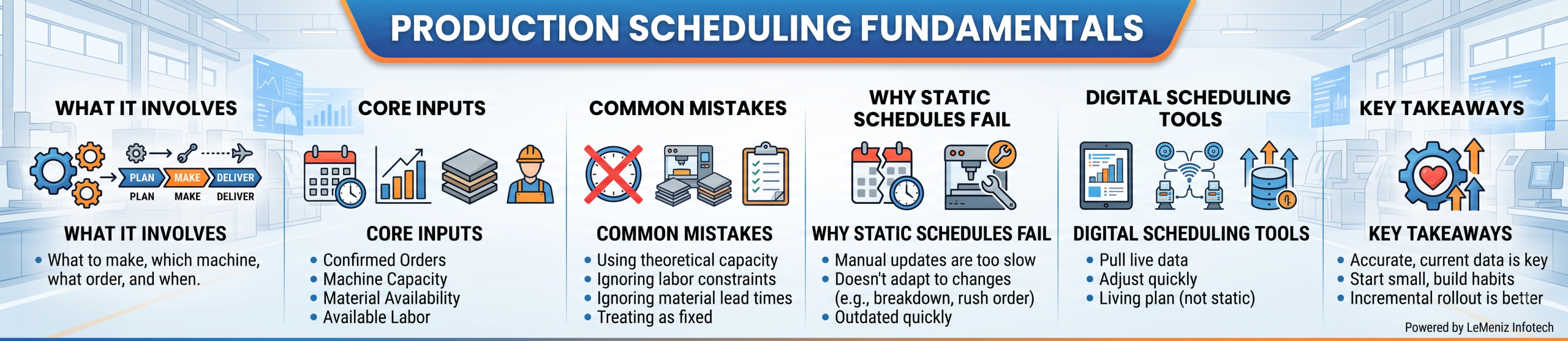
Production scheduling is the process of deciding what gets made, on which machine, in what order, and by when. It sounds straightforward, but doing it well requires balancing customer deadlines, machine capacity, material availability, and workforce constraints all at once, which is why so many factories still struggle with late orders despite having capable equipment and skilled operators.
The Core Inputs to Any Schedule
A workable production schedule depends on accurate information in four areas: confirmed customer orders and deadlines, real machine capacity including planned downtime, current material and inventory availability, and available skilled labor for each job. When any of these inputs is wrong or outdated, the resulting schedule looks fine on paper but falls apart on the shop floor.
Common Scheduling Mistakes
- Scheduling based on theoretical machine capacity rather than actual historical output, which is almost always lower due to changeovers, minor stoppages, and quality holds
- Not accounting for skilled labor availability, assigning a job to a machine without checking whether a certified operator is actually scheduled for that shift
- Ignoring material lead times, scheduling a job to start before the required raw material is confirmed to arrive
- Treating the schedule as fixed rather than adjusting it as real conditions change during the day
Why Static Schedules Fail
Many plants still create a schedule at the start of the week and stick to it regardless of what actually happens on the floor. When a machine goes down unexpectedly or a rush order comes in, the schedule that looked correct on Monday morning is no longer accurate by Monday afternoon, yet supervisors often keep working from the outdated version because updating it manually is too time-consuming.
What Digital Scheduling Tools Change
A digital production scheduling system pulls in live data on machine status, material availability, and skill matrix information, allowing schedules to be adjusted quickly when conditions change rather than requiring a full manual rebuild. This turns scheduling from a static weekly exercise into a living plan that reflects what is actually happening on the floor.
The Bottom Line for Factory Managers
Good scheduling is less about sophisticated algorithms and more about having accurate, current data available when decisions need to be made. Factory managers who invest in getting real-time visibility into capacity, material, and labor constraints consistently see fewer missed deadlines than those relying on scheduling based on outdated assumptions.
Production Scheduling Fundamentals: Key Takeaways
Getting production scheduling fundamentals right is less about chasing the latest trend and more about building a habit of measuring before you change anything. Teams that succeed usually start with a single, well-defined process, track it consistently, and only then expand what they’ve learned to the rest of the plant. That disciplined, incremental approach to production scheduling fundamentals tends to outperform a single big-bang rollout, because each step is validated with real data before the next one begins.
If you’re evaluating production scheduling fundamentals for your own operation, it helps to talk with a team that has actually implemented it elsewhere, not just read about it. LeMeniz Infotech has supported manufacturers and engineering students with practical, hands-on guidance since 2011, and we’re happy to walk through real examples of production scheduling fundamentals in practice before you commit to anything.
For broader context on manufacturing modernization standards, see the NIST manufacturing resource center. To see how production scheduling fundamentals fits into a complete digital factory rollout, explore our Digital Factory suite from LeMeniz Infotech.
Teams rolling out production scheduling fundamentals for the first time often underestimate how much of the early value comes from simply having consistent, accurate data to look at, rather than from any single advanced feature. Getting the basics right and building the habit of reviewing that data regularly tends to matter more in the first few months than choosing the most sophisticated available option.