

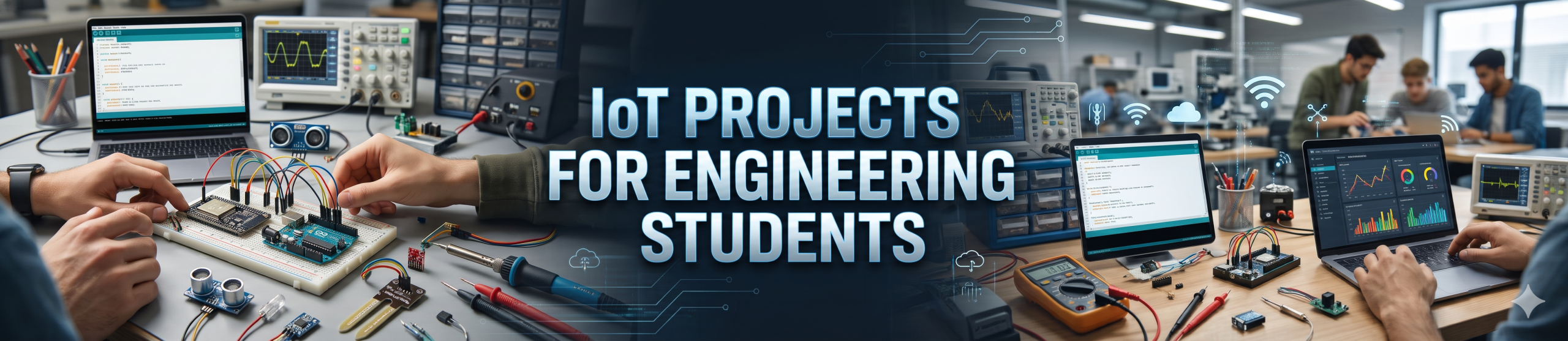
This guide covers IoT projects for engineering students: what it means, how it works, the mistakes to avoid and how we approach it in real projects.
IoT project ideas for engineering students with real-world uses include smart agriculture monitoring, a home energy meter, air-quality sensing, smart waste bins, a patient vitals monitor, a vehicle tracker, smart street lighting and an industrial machine health monitor. Pick one with accessible sensors, a clear data flow and measurable outcomes.
Table of Contents
Key takeaways on IoT projects for engineering students
- Choose sensors and boards that you can source easily.
- Design the full path: sensor, microcontroller, network, cloud and dashboard.
- Measure accuracy, latency, power use and cost.
- Plan power, enclosure and connectivity realistically.
- Add security basics such as authentication and encrypted transport.
Typical IoT architecture
Most IoT projects follow the same chain: sensors measure the physical world, a microcontroller such as ESP32 or Arduino reads them, a network link using Wi-Fi, LoRa or cellular sends data, a cloud service stores it, and a dashboard or app shows results and sends alerts. Choose protocols such as MQTT for lightweight messaging, and design for unreliable connections.
Project ideas
| Idea | Sensors and hardware | Real-world value |
|---|---|---|
| Smart agriculture | Soil moisture, temperature, ESP32 | Water saving and crop care |
| Home energy monitor | Current sensor, ESP32 | Cut electricity bills |
| Air-quality station | PM2.5, gas and humidity sensors | Health awareness |
| Smart waste bin | Ultrasonic sensor, GSM or Wi-Fi | Efficient collection |
| Patient vitals monitor | Heart rate and temperature sensors | Remote care (prototype only) |
| Vehicle tracker | GPS and GSM module | Fleet safety |
| Machine health monitor | Vibration and temperature sensors | Early fault signs |
Build steps
- Define the problem and what you will measure.
- Select sensors, board and connectivity.
- Prototype on a breadboard and verify readings.
- Send data to a cloud service and store it.
- Build a dashboard with charts and alerts.
- Calibrate, test in real conditions and record results.
- Design an enclosure and power plan.
Evaluation and metrics
Compare sensor readings with a trusted reference, measure packet loss and delay, record battery life and estimate bill-of-materials cost. Test in the environment where the system will actually run, because lab results often differ. Document limitations such as range, accuracy and weather sensitivity.
Security and safety
- Change default credentials and use authentication.
- Encrypt data in transit with TLS where possible.
- Keep firmware updatable.
- Follow electrical safety for mains-connected devices.
- Do not claim medical accuracy for educational prototypes.
Choosing sensors and boards sensibly
The hardware you choose shapes everything that follows. For learning and prototypes, ESP32 boards are popular because they combine a capable processor, Wi-Fi and Bluetooth at a low price. Arduino boards are simple and well documented. Raspberry Pi suits projects needing a full operating system, camera processing or local dashboards. For long-range, low-power deployments, LoRa modules are worth considering, and for vehicles or remote areas a GSM module provides coverage where Wi-Fi does not.
Sensor quality varies widely. Cheap soil moisture probes corrode, low-cost gas sensors need calibration and many temperature sensors drift. Read data sheets, buy from reputable suppliers and plan calibration against a trusted reference. Document the accuracy you actually achieved, not what the catalogue claims.
Networking and data protocols
Data must travel from the device to the cloud reliably. MQTT is a lightweight publish-subscribe protocol widely used in IoT because it works well on unreliable connections and small devices. HTTP is simpler to start with but heavier. Decide how often to send data, whether to batch readings, and how the device behaves when the network drops. Store readings locally and upload when connectivity returns.
On the cloud side, choose a service you can manage: a managed IoT platform, a simple server with a database or a free-tier dashboard tool. Think about data retention, access control and costs. A project that logs a reading every second can generate a surprising amount of data over a few months.
Dashboards, alerts and user experience
A good IoT dashboard answers a question at a glance: is everything normal, and if not, where is the problem? Use clear charts, thresholds with colour coding and a timeline of events. Alerts by SMS, WhatsApp or email make the system useful when nobody is watching the screen, but avoid flooding users with notifications by setting sensible thresholds and delays.
Think about the person who will use the system. A farmer needs a simple display in their own language, not a technical console. Test the interface with real or representative users and refine based on what confuses them.
Power, enclosure and field testing
Prototypes that work on a desk often fail outdoors. Heat, dust, moisture, vibration and unstable power can all cause trouble. Choose an enclosure with suitable protection, seal cable entries and use proper connectors rather than loose jumper wires. Calculate battery life from the current drawn in active and sleep modes, and use deep sleep to extend it. For solar-powered nodes, size the panel and battery for cloudy days.
Run a field test for at least a few days in the real environment and record failures. Describe the problems and fixes in your report; this practical learning is highly valued by evaluators.
Documenting and presenting an IoT project
IoT projects live or die on demonstration. Prepare a clear architecture diagram showing sensors, microcontroller, communication, cloud and dashboard. Keep a bill of materials with part numbers and costs, wiring diagrams, flowcharts of the firmware logic and screenshots of the dashboard. Record a short video of the system running in a realistic setting as a backup if hardware fails during the viva.
In the report, describe calibration procedures, sampling intervals, filtering methods and how you validated readings. Include graphs that compare your sensor values against a reference instrument, along with an honest error analysis. Examiners appreciate understanding of noise, drift and environmental effects.
Discuss scale-up. How would the design change if you deployed one hundred nodes instead of one? Consider provisioning, over-the-air updates, device management, data volume and cost. Even a short section on this shows systems thinking.
Ethics, privacy and safety
IoT systems collect data about places and people. If your project monitors homes, workers or patients, explain what is collected, who can access it and how it is protected. Use anonymisation where possible and secure communication. For health-related prototypes, state clearly that the device is not a certified medical product. For mains-powered systems, follow electrical safety practices, use isolation and fuses and never demonstrate unsafe wiring.
Latest trend: edge-to-dashboard visibility
Industrial IoT increasingly connects field data to live dashboards. In our Digital Factory project we have implemented a live dashboard for production status, safety compliance and inventory, together with digital checksheets and workflows. Student IoT projects can mirror that: capture structured readings and present them clearly. Vendors highlight edge AI and unified data layers; these are emerging trends, so focus first on a reliable end-to-end prototype.
Why IoT projects for engineering students matters
A clear approach to IoT projects for engineering students saves time, avoids costly rework and helps you decide with confidence. Whether you are a business owner, a manager or a student, the points above give you a practical starting position.
In summary, treat IoT projects for engineering students as an ongoing practice rather than a one-time task: start small, measure the result, and improve every month. Good IoT projects for engineering students decisions come from clear goals, honest data and steady follow-through.
Frequently asked questions
Which board is best for beginners?
ESP32 and Arduino are popular, with strong community support.
Do I need cloud services?
Not always, but cloud dashboards make projects more impressive and practical.
How do I power outdoor devices?
Use batteries with low-power modes or solar charging where suitable.
How do I make the project original?
Combine sensors in a new application and evaluate against existing options.
Where can I get help with IoT projects for engineering students?
Our team can review your situation and suggest a practical plan for IoT projects for engineering students. Contact us through the website to start a conversation.
Looking for an IoT project with hardware and dashboard support? Contact our team. Ask us about IoT projects for engineering students today.
